


The quality check plays a vital role in any field, as it does in software development. For that process, many techniques are used by QAs; however, the two main approaches to having that testing are manual testing and automated testing. Depending on the need and efficiency of the method, analysts use one of the methods or sometimes both.
Each approach has unique benefits and drawbacks that affect how resources are allocated and how effectively tests are conducted.
In order to assist testers in determining when to use automation versus manual testing, this blog will examine both strategies and when to use which. Also, it will throw a light on selecting an affordable software testing company in India.
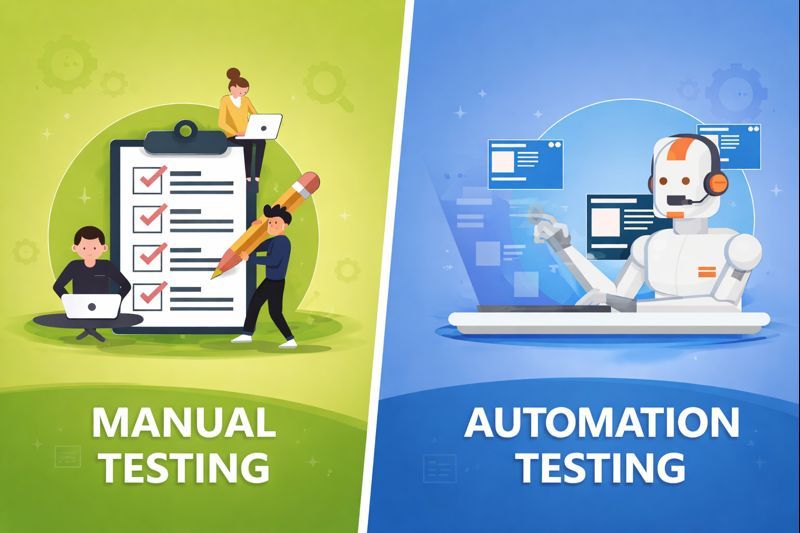
Manual Testing
Manual testing is a kind of software testing where no tools or automation are used. Testers create test cases for the code, test the program, and provide a final report on the program. As manual testing is done by humans, mistakes are common, and it can take time in the process.
- To find faults in the developed software program, manual testing is done.
- The tester examines every crucial aspect of the program.
- Without assistance from the automation tools, the tester runs test cases and produces test results.
- To complete the testing procedure, it is carried out by the skilled tester.
And at Beesolver Technology, our analysts are the best at their work, which is seen through the results and positive feedback of our clients.
When Should Manual Testing Be Done?
When automation is insufficient or cannot be used, manual testing is carried out. Key causes and situations are as follows:
- Exploratory testing: It is the process of identifying problems with novel or ambiguous aspects through investigation.
- Usability testing: Verifying that the user interface is both aesthetically pleasing and simple to use.
- Ad-Hoc Testing: Conducting brief, informal tests following issue patches or updates.
- Visual testing: Examining the design, color scheme, and overall appearance of the website in various browsers.
Improve your testing techniques and guarantee the quality of your software using the appropriate testing methodology and choosing the right software testing company in India.
When should Manual Testing be Done?
When automation testing is not enough or there are some specific guidelines, then manual testing is the choice. Some of the reasons are:
- When flexibility is the main goal.
- For short-term projects.
- When evaluating end-user usability.
Advantages of Manual Testing
Some of the main advantages of manual testing are listed below.
- More people can participate in manual testing, which makes the recruiting process easier.
- It makes it easier to provide quick and accurate software feedback.
- It is possible to use manual test cases in a variety of testing settings.
- This method readily adjusts to changes in the user interface.
- Due to its cost-effective feature, this method is more preferred.
Difficulties with Manual Testing
If anything has benefits, it has flaws too; nothing is perfect. Some of the challenges with manual testing are listed below:
- Since 100% test coverage is not guaranteed, some faults might not be found.
- Even though everyone can perform manual testing, complex scenarios could require more skill.
- It takes a lot of time and effort to manually write and run test cases for every functionality.
- The inability to record or repurpose the procedure limits its effectiveness for subsequent testing.
- The possibility of human mistake in test design and execution makes manual testing less dependable.
Automation Testing:
Automation testing is a method of testing where the testing is carried out with the aid of tools (automation). This method is quicker than the manual one; that’s why it is preferred. There is no possibility of human error.
To compare actual outcomes with projected results, it solely depends on a pre-scripted test that operates automatically.
The tester can ascertain whether or not the application operates as intended with the aid of automated testing.
Regression testing and repetitious jobs can be carried out with it easily.
Still, some of the manual efforts are required for the initial proceedings; that can be a limitation for this approach.
When Should Automation Testing Be Done?
- When performing repetitious chores is necessary.
- In the case of regression testing.
- When there is a shortage of human resources.
Advantages of Automated Testing
Some of the benefits of automated testing are listed below:
Finds more bugs: Automation testing aids in identifying further software flaws.
Regression testing can be completed faster with automated tests because they can be run again on a regular basis.
One advantage of employing automation tests is that the process may be documented, which makes it possible to reuse the tests.
No tiredness: Unlike manual testing, automation uses software tools to carry out tests; therefore, there is no fatigue or tiresome element.
Increased test coverage: By ensuring that not even the smallest unit is left untested, automation tests contribute to increased test coverage.
Automation Testing’s Drawbacks
These are limitations of automation testing too; they are briefed below:
Difficult to analyse visual components: Since there is no human involvement in automated tests, it is challenging to gain insight into visual components like color, font size, font type, button sizes, etc.
Expensive: Automation tests are expensive to implement since they require tools, which raises the project budget.
Test maintenance is expensive: Test maintenance for automated tests is expensive.
Not false proof: Errors and omissions can occur in automated tests due to their limitations.
Workers with training are needed: Trained personnel with programming language and testing expertise are needed to do automated tests.
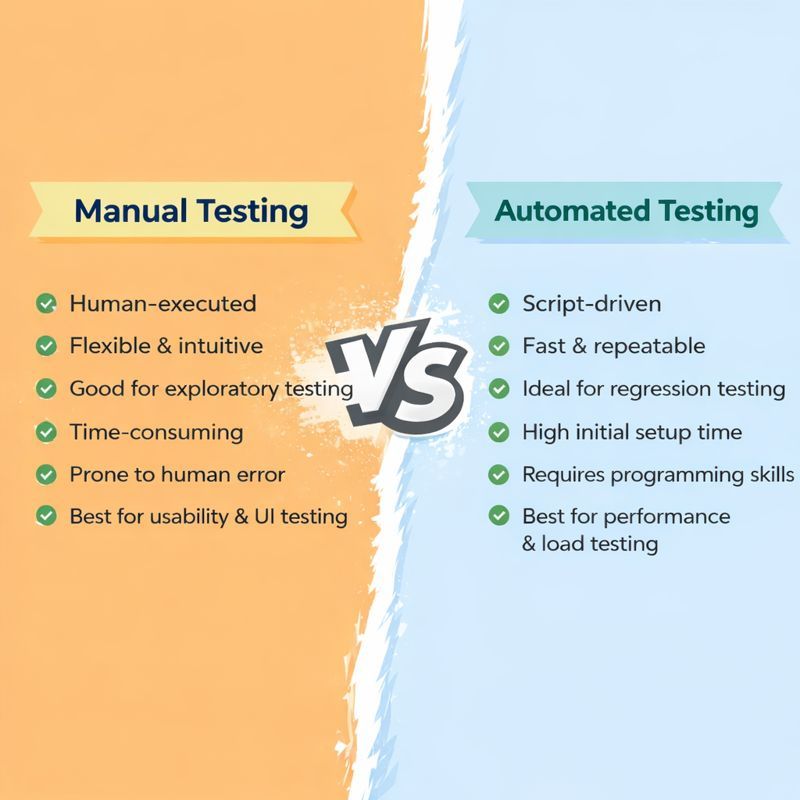
How to Decide between Automated and Manual Testing
When choosing between automated and manual testing, it’s important to look at the size of your project, the resources you have, and which approach works best for each testing need.
Automation works best for large projects, such as ERP or CRM systems that require frequent testing. As the number of test cases grows, manual testing can become slower, costlier, and more prone to human errors. This can lead to delays and increased risk. Automated testing helps manage large test suites more efficiently and ensures thorough coverage without putting extra pressure on your QA team.
Test frequency: Automation is a vital tool if you have features that require regular testing. Regression testing with each new build or software upgrade is one scenario where it performs exceptionally well. By ensuring uniformity and saving time, automating these procedures lowers the possibility of human error.
Resource availability: Although automation has obvious advantages for large-scale projects and frequent testing, it’s crucial to take the resources needed to put it into practice into account. Automation may first require a tool and development expert expenditure.
Conclusion
Having a balance between manual and automated testing is crucial for a highly productive team creating amazing websites and applications. This will allow the quick deployment of error-free websites and applications while keeping expenses under control.
Mapping out the kinds of tests that will be performed manually and those that will be automated is crucial. Following that, capacity planning should be done for both manual testing (i.e., the number of users) and automation testing (i.e., the number of users and parallels). As a result, the ideal solution that maximizes coverage, speed, and expenses can be developed.
We at Beesolver Technology, Manual and automation software testing company in India, are here to assist you in improving your operational efficiency as we make use of both approaches for better results and bug-free software.
FAQS
1. What is the difference between automated and manual software testing?
There is a clear difference between manual testing and automated testing. Manual software testing is done by human testers, whereas automated testing is performed using software tools.
2. In what situations manual testing better than automated testing?
The visual validation and short-term projects should be done better manually. Like this, many other situations are also there; however, each one is better in its own way.
3. Is automated testing error-free?
No, automated testing is not error-free, but it minimizes human error.
